Just yesterday, a political acquaintance leaned in me on a busy Malé street corner, lowering his voice into a hushed, conspiratorial tone.
"Did you hear?" he whispered, glancing nervously over his shoulder. "President Muizzu is visiting Pakistan, and New Delhi is furious. There is real panic that India might impose trade restrictions, inflate essential commodity prices, or halt exports of rice, flour, and sugar to us altogether!"
His voice trembled with manufactured anxiety. Yet, this narrative is all too familiar. Whenever the Maldives takes decisive steps to diversify its international partnerships, a certain political faction predictably releases "doomsday" rhetoric into the public sphere. It is a calculated fearmongering strategy designed to keep the Maldivian public tethered to India and fixated on regional anxiety.
The truth, however, is starkly different: these dire warnings are hollow political theater. The Republic of Maldives is a sovereign, independent Islamic nation—not a backyard vassal state destined to live under the overbearing shadow of any single regional power, be it India or anyone else.
A Landmark Visit Beyond Symbolic Protocol
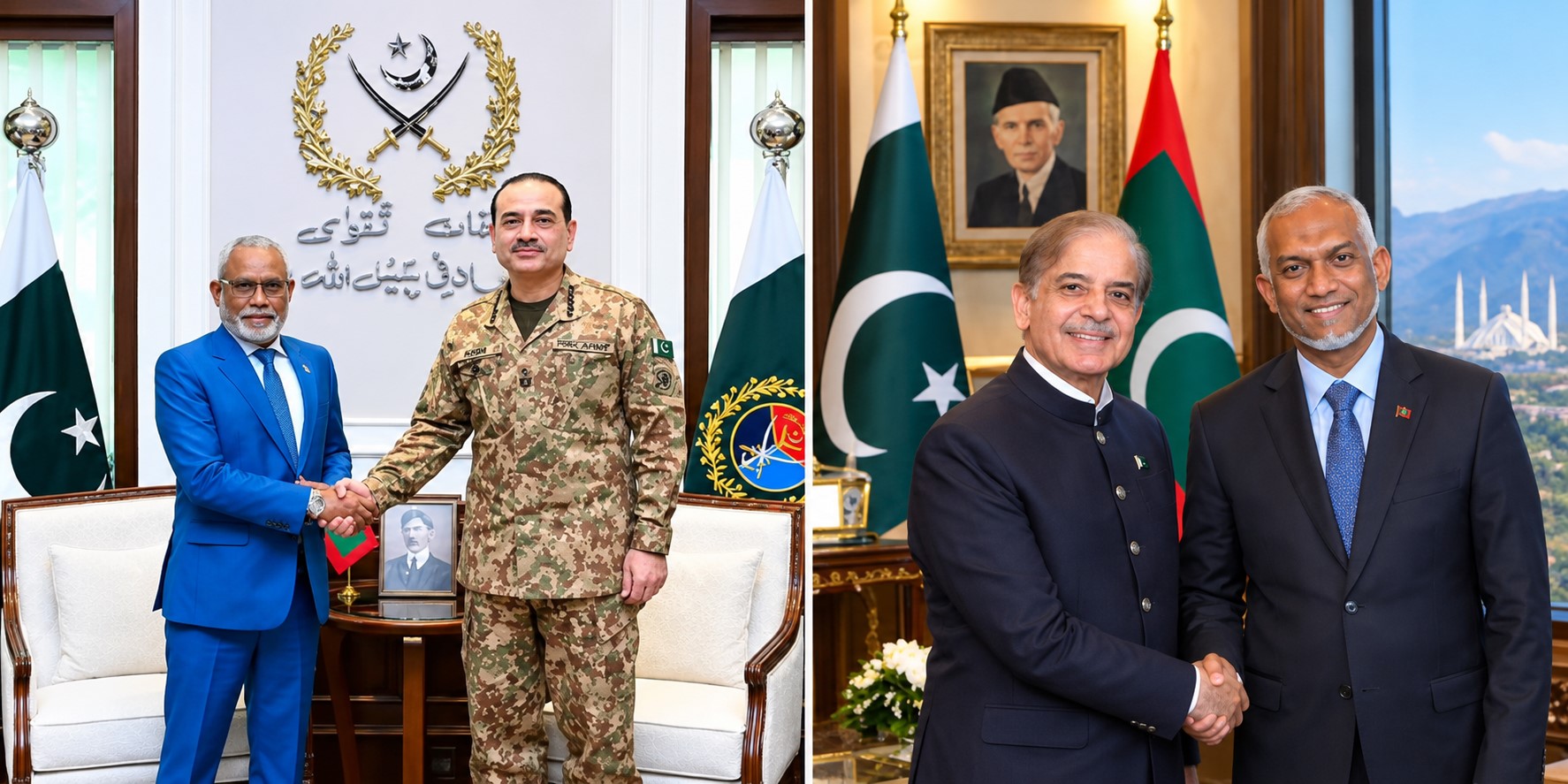
President Dr. Mohamed Muizzu’s state visit to Pakistan from October 20 to October 22 marks the first visit by a Maldivian Head of State to Islamabad in eleven years. Marking the 50th anniversary of formal diplomatic relations established in 1966, this visit carries significance far beyond ceremonial symbolism. It sends an unmistakable signal to the global community: the Maldives is actively re-engaging with key Asian and Islamic par tners to assert its foreign policy autonomy.
Maldives and Pakistan, together to revive SAARC and strengthen joint advocacy at the UN and the OIC
During the visit, high-level talks are slated with Pakistani Prime Minister Shehbaz Sharif, President Asif Ali Zardari, and parliamentary leaders. Central to the agenda is the signing of 12 landmark MOUs and agreements spanning trade expansion—anchored by the launch of the Pakistan-Maldives Business Forum. Furthermore, bilateral cooperation will target climate change resilience, civil aviation, maritime security, and reviving stalled regional mechanisms like the South Asian Association for Regional Cooperation (SAARC), while strengthening joint advocacy at the United Nations and the Organization of Islamic Cooperation (OIC).
This trip by President Muizzu builds on solid diplomatic momentum. Following Speaker of Parliament Abdul Raheem Abdulla’s delegation visit to Islamabad last September—where the Maldives commended Pakistan’s principled stands on Palestine and Kashmir—Pakistan established a high-level reception committee led by Deputy Prime Minister and Foreign Minister Ishaq Dar. This gestures deep mutual respect and a shared commitment to elevated bilateral ties.
Escaping Regional Hegemony: Prioritizing the National Interest
For decades, Maldivian foreign policy operated under an unwritten "India First" posture that effectively prioritized New Delhi's regional sensibilities over broader national development. In a rapidly shifting multipolar world, absolute reliance on a single neighbor is neither strategic nor prudent. While India and Pakistan remain geopolitical adversaries, their rivalry is an independent bilateral matter. India’s adversaries do not automatically become enemies of the Maldives.
Maldivian foreign policy need not be tailored to suit the strategic preferences of New Delhi
Maldivian foreign policy must be formulated in Malé, dictated strictly by the socio-economic interests and security needs of the Maldivian people—not tailored to suit the strategic preferences of New Delhi. Expanding diplomatic, educational, healthcare, and defense ties with Pakistan poses no hostile threat to India; rather, it represents a vital step toward securing the Maldives' multi-vector stability.
The Pragmatism of Strategic Diversification
Since assuming office, President Muizzu has spearheaded a recalibrated diplomatic posture, building robust strategic and economic partnerships across Turkey, China, the UAE, Qatar, and Saudi Arabia. This approach directly addresses the nation’s pressing fiscal vulnerabilities and economic diversification goals. A prime illustration of this strategy is the ambitious Ras Malé urban development project—an eco-friendly mega-reclamation undertaking designed to solve housing shortages and expand economic space—alongside the landmark decision to establish the $8.8 billion Maldives International Financial Center in Malé, in partnership with Dubai’s MBS Global Investments and the Private Office of Qatar’s Sheikh Naif Bin Eid Al Thani. These historic endeavors underscore a resolute push to secure financial independence, expand infrastructure, and shield the sovereign economy from external leverage.
Unlike previous administrations that risked over-reliance on a single power broker such as India, President Muizzu’s doctrine balances strategic multi-alignment. The administration maintains working economic relations with India without sacrificing national dignity or limiting ties with the wider Islamic world and China.
Balanced Bilateralism Without Subservience
Critiques claiming the Maldives has severed ties with India ignore recent diplomatic realities. In October 2024, President Muizzu undertook a successful state visit to India, effectively defusing prior bilateral friction. When Maldivian foreign exchange reserves dipped to $140 million and credit ratings faced severe pressure, India extended financial support mechanisms, affirming its role as an important regional neighbor and trade partner. Accepting neighborly cooperation, however, does not require submission. As a small island state navigating complex Indian Ocean dynamics, the Maldives must adhere to a principle of "Friends to all, subservient to none."
Conclusion: Fear Cannot Guide National Destiny
President Muizzu’s state visit to Pakistan is a courageous assertion of foreign policy independence and regional equilibrium in the Indian Ocean. Sensationalist claims of impending economic blockades or trade cutoffs are baseless rumors meant to undermine sovereign confidence.
Though small in geographical footprint, the Maldives possesses unyielding national dignity and sovereignty. Strengthening ties across Saudi Arabia, the UAE, Turkey, Pakistan, China, and the broader Islamic world is essential to safeguarding our economy, reinforcing our defense architecture, and ensuring prosperity for future generations. It is time to step decisively out from under New Delhi’s shadow and stand proudly on our own two feet.