His wife handed him a cup of tea. “Ready tha?”
“Aan,” Ahmed said. He drank the cup of black tea quickly. His daughter was still asleep.
Ahmed looked at her for a moment. She was eight and her school time is the afternoon session. He smiled. That small smile was probably the most genuine smile he would produce that morning. He quietly checked his wallet, hoping that he would somehow find a bundle of 500 Rufiyaa notes in it. There was very little inside. He put it back into his pocket.
His wife noticed. Her heart felt a silent sob. At 8:03, Ahmed slid down the almost vertical staircase, like a fireman in a drill, and began his journey to work. The Mart where he works as a salesman was not far away. Every day, Ahmed calculated transport against everything else. Sometimes he took a bus. Sometimes he simply told himself that walking was good exercise.
There were many things poor people learn to call “choices.” At the Mart, Ahmed became someone else.
“Assalaamu alaikum.”
“Wa alaikum salaam.”
“Kihineh?”
“Rangalhu.”
Customers came and went. Ahmed arranged shelves. He carried cartons. He swept the floor. He stood behind the counter. He smiled when required. He knew the prices of almost everything in the shop. Milk. Rice. Cooking oil. Biscuits. Baby products. Soft drinks. He knew what had become expensive. He knew which customers checked prices before buying. He knew which mothers quietly returned something to the shelf after looking at the total price. He knew because he did exactly the same thing at other shops. Around midday, one of his old acquaintances walked in.
“Eh Ahmed! Kihineh?”
Ahmed smiled. “Rangalhu.”
“Where have you disappeared? We don't see you anymore.”
Ahmed laughed. “Busy.”
The friend smiled. “Come for coffee sometime, man.”
“Insha Allah.”
The friend left. Ahmed turned back to the shelves. He knew there would be no coffee.
Not because he didn't like coffee. Because coffee with friends was no longer simply coffee.
There was the coffee. The transport. Perhaps something to eat. Perhaps another round.
Perhaps someone suggesting dinner. Ahmed had learned that saying “I can't afford it” was more uncomfortable than saying “I'm busy.”
So he was always busy. Ahmed is slowly discovering that in the race to provide for his family, he may be missing the very life he is working so hard to provide for them. Ahmed sometimes wonders whether earning a living really has to mean giving up almost the whole of one's life. The Mart opens around seven in the morning and closes around eleven at night. For workers like Ahmed, the day can feel endless. There is a short break around noon, and another from six until eight in the evening. Then it is back to the shop, back to the shelves, back to the counter.
And Saturday, the school holiday, is no different. While his daughter is at home, free from school and perhaps hoping that her father might spend the day with her, Ahmed is at the Mart. The shop is open, and so is his working day. By the time Ahmed returns home, his daughter may already be asleep. He wonders whether shops really need to remain open so late. Why not close around 8 p.m.? Perhaps people could shop earlier. Perhaps businesses could adjust. Perhaps workers like Ahmed could actually sit down for dinner with their families, hear their children talk about their day, help with homework, or simply be at home while their children are still awake. A society should not measure prosperity only by how late its shops remain open. Sometimes prosperity is also having a father come home early enough to watch his daughter grow up.
At around 3 p.m., Ahmed checked his phone. There was a message from his wife.
“Can you bring something for dinner when you come?”
Ahmed looked at the message for a few seconds. He knew what little was at home. He knew what was in his wallet. He typed:
“OK. Insha Allah.”
Then he put the phone away. He would figure it out. Ahmed always figured it out.
That was the problem. Because when a man always manages somehow, people eventually assume that he is doing fine. A little after six, his daughter called him.
“Bappi!”
His face changed immediately.
“Yes dharifulha?”
She was excited.
She had seen something. A toy. One of those colourful things displayed in a shop window, the kind of toy children notice immediately and fathers notice with a slight tightening in the chest.
“Bappi, I want this one.”
Ahmed smiled. “Hmm.”
“Please?”
He looked at it. Then at the price. He already knew the answer. “Later.”
“When?”
Ahmed laughed softly. “Soon.”
She accepted the answer because she trusted her father. That hurt him more than if she had cried. On the way home, Ahmed bought something small for her instead.
It wasn't what she had asked for.
But when he handed it to her, she smiled.
“Thank you Bappi!”
Ahmed smiled back. For a few seconds, he forgot everything. The rent. The bills. The worn shirt. The empty wallet. The twentieth of the month. All of it disappeared. His daughter's smile was free. And it was perhaps the most expensive thing in his life. Later that night, his wife mentioned a dress she had seen. Not directly. She never directly asked.
She said: “Mi dress varah Reethi dho?”
Ahmed knew. He looked at the photo of the dress on her phone. “Aan. Varah reethi.”
There was silence. Her eyes had a question! Ahmed didn't answer immediately.He wanted to say yes. He wanted to tell her: Choose whichever one you like. He wanted to be the husband who could do that. Instead he said: “Later insha Allah.”
She smiled. “Okay.”
She didn't complain. That somehow made it worse. By the 20th of the month, Ahmed's salary had already disappeared. Not literally. It had simply been converted into other people's needs. Rent. Food. School. Electricity. Water. Transport. Household necessities.
Small emergencies. Things that could not be postponed. His salary had entered his account and left almost immediately. The last ten days of every month were tougher. During those ten days, Ahmed became inventive. He asked around for extra work.
Sometimes someone needed help moving something. Sometimes there was a delivery.
Sometimes he worked a few extra hours. Sometimes there was nothing. On the days when there was nothing, he worried. But he didn't tell his wife. Not fully. Because she was worried too. And there is a peculiar loneliness in marriage when both people are frightened about the same thing but each tries to hide their fear from the other. Ahmed loved his wife.
He loved his daughter. But love does not pay rent. Love does not fill the gas cylinder. Love does not buy the material needed for CA subject every week at school. So, Ahmed kept working.
His parents sometimes asked why he hadn't progressed further. “Still working at that Mart?”
“Hmm.”
“You should try something else.”
“I am trying.”
“Why don't you start something?”
His parents meant well. Perhaps they genuinely believed Ahmed could do more. His siblings had their own lives, their own bills, their own holiday trips and shopping. Nobody was deliberately abandoning him. That was almost the saddest part. Ahmed wasn't surrounded by bad people. He was surrounded by people who simply didn't know how difficult his life had become. And Ahmed had become very good at making sure they didn't know.
There are evenings when Ahmed walks home and passes restaurants filled with people.
He sees friends sitting together. He sometimes recognizes them. Someone sees him.
“Kihineh Ahmed?”
“Rangalhu.”
“Where are you these days?”
“Busy.”
“Come join us.”
Ahmed smiles. “Perhaps another time.”
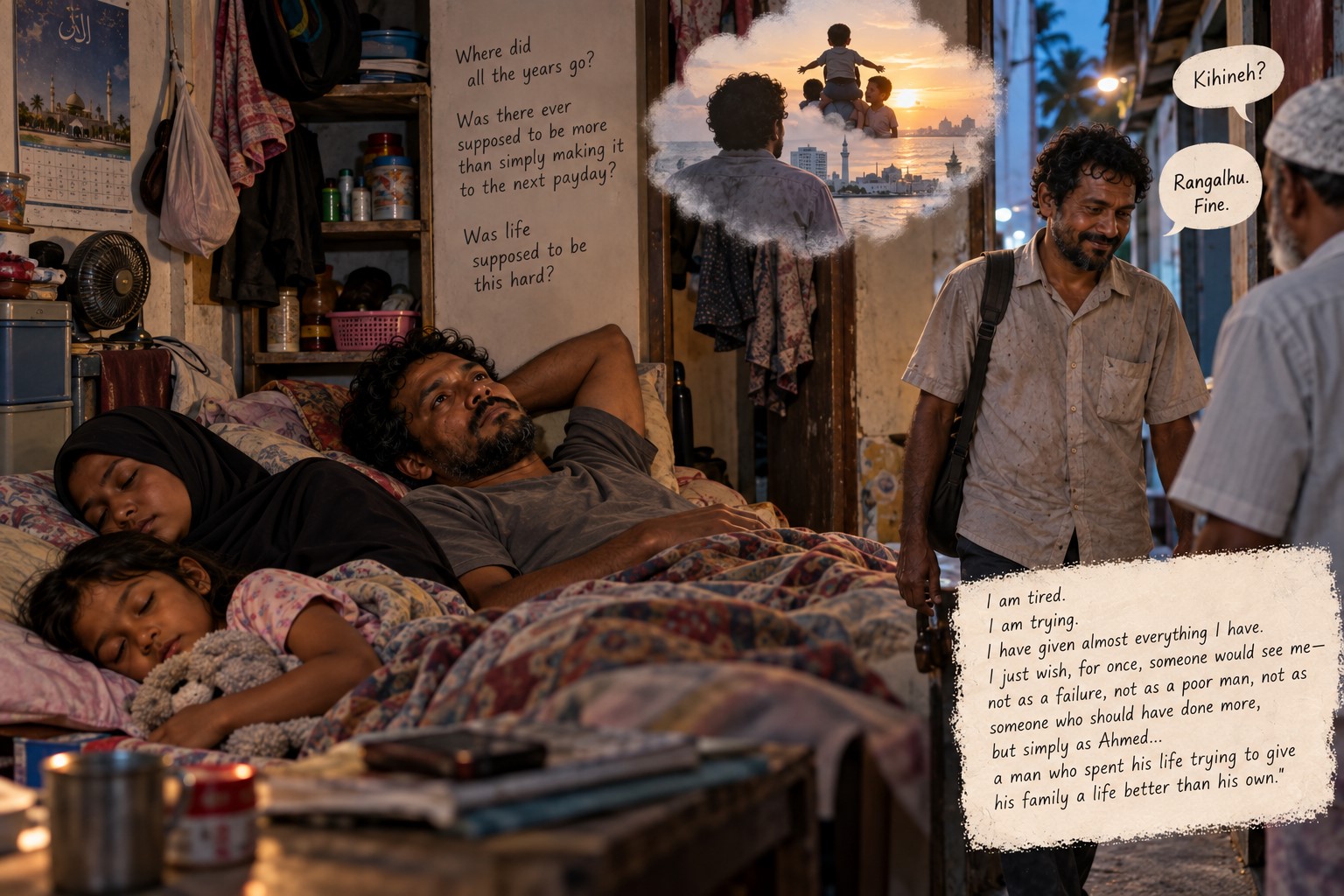
He keeps walking. They probably think he is uninterested. He isn't. He simply cannot afford to sit down. That is a different kind of loneliness. Having people around you, but feeling that you cannot afford to belong among them. At night, after his daughter has fallen asleep, Ahmed sometimes lies awake. His wife beside him. The room is quiet. The refrigerator hums in the corner. A motorcycle passes outside. Ahmed looks at the ceiling. He thinks about his age. Thirty-nine. He remembers being twenty. At twenty, he thought thirty-nine was old. Now he wonders where those nineteen years went. He had imagined that by this age he would own a home, have savings, own a small business, own a motorcycle, and secure a comfortable life for his family. Instead, he owns very little, rents a room that is called an apartment, has a small job. He has a daughter who thinks her father can buy anything.
Ahmed closes his eyes. Tomorrow he will wake up and do it again. Work. Earn. Pay. Borrow.
Manage. Repeat. Years pass this way. Perhaps twenty years from now his daughter will be grown. Perhaps she will marry and leave. Ahmed will be 59, and on the cusp of the dreaded 60 years! His wife will be older. The small room may still be rented. The bunker bed would have disappeared after the daughter marries and leaves. The toys and the schoolbooks would be gone. The school fees would have become a memory, and Ahmed may finally ask himself: “What did I achieve?”
Perhaps the answer will be simple. I raised my daughter. Perhaps that is a magnificent achievement. But perhaps a society should ask another question too: “Why did raising a family have to mean sacrificing an entire lifetime?”
We often ask people: “Kihineh?”
We ask it when we meet them on the road. At the shop. At work. At the mosque. At a funeral. The reply is almost always: “Rangalhu”. But we rarely persisit for the real answer.
Ahmed says “Rangalhu” a dozen times a day. He says it because explaining details is exhausting and most people really don’t care. He says it because he doesn't want pity.
He says it because he doesn't want to appear unsuccessful. He says it because he doesn't want to burden anyone. He says it because his parents already think he should be doing better. He says it because his friends have their own problems. He says it because his wife is already carrying enough. He says it because his daughter needs a father who looks strong. And perhaps, after saying it enough times, he has even started believing it himself.
“Rangalhu”.
But Ahmed is not fine. He is surviving. Perhaps the next time we meet someone like Ahmed and ask, “Kihineh?”, we should not be so quick to walk away after hearing “rangalhu.”
Maybe we should sit down, buy the coffee and ask again. This time waiting for the real answer. Because, sometimes the person standing in front of us is not looking for money, or a job and not even sympathy. Maybe he is simply looking for someone who will finally notice that behind the word “rangalhu” is a human being who has been quietly struggling for years. And perhaps the greatest kindness we can offer him is not to tell him that he should have done better. It is to let him know: “You don't have to pretend with me.”
And perhaps, somewhere tonight, Ahmed is lying awake in that one small room, listening to his daughter breathe in her sleep. He looks at his wife beside him and wonders whether life was supposed to be this hard. He wonders where all the years went, and whether there was ever supposed to be more than simply making it to the next payday. He may never tell anyone these things. Tomorrow, he will put on that same worn shirt, straighten his collar, walk to the shop and smile when someone asks him, “Kihineh?” And, as he always does, he will probably answer, “Rangalhu.” Fine. But perhaps, if we listen carefully enough, we might hear what he cannot say: “I am tired. I am trying. I have given almost everything I have. I just wish, for once, someone would see me—not as a failure, not as a poor man, not as someone who should have done more, but simply as Ahmed… a man who spent his life trying to give his family a life better than his own.”