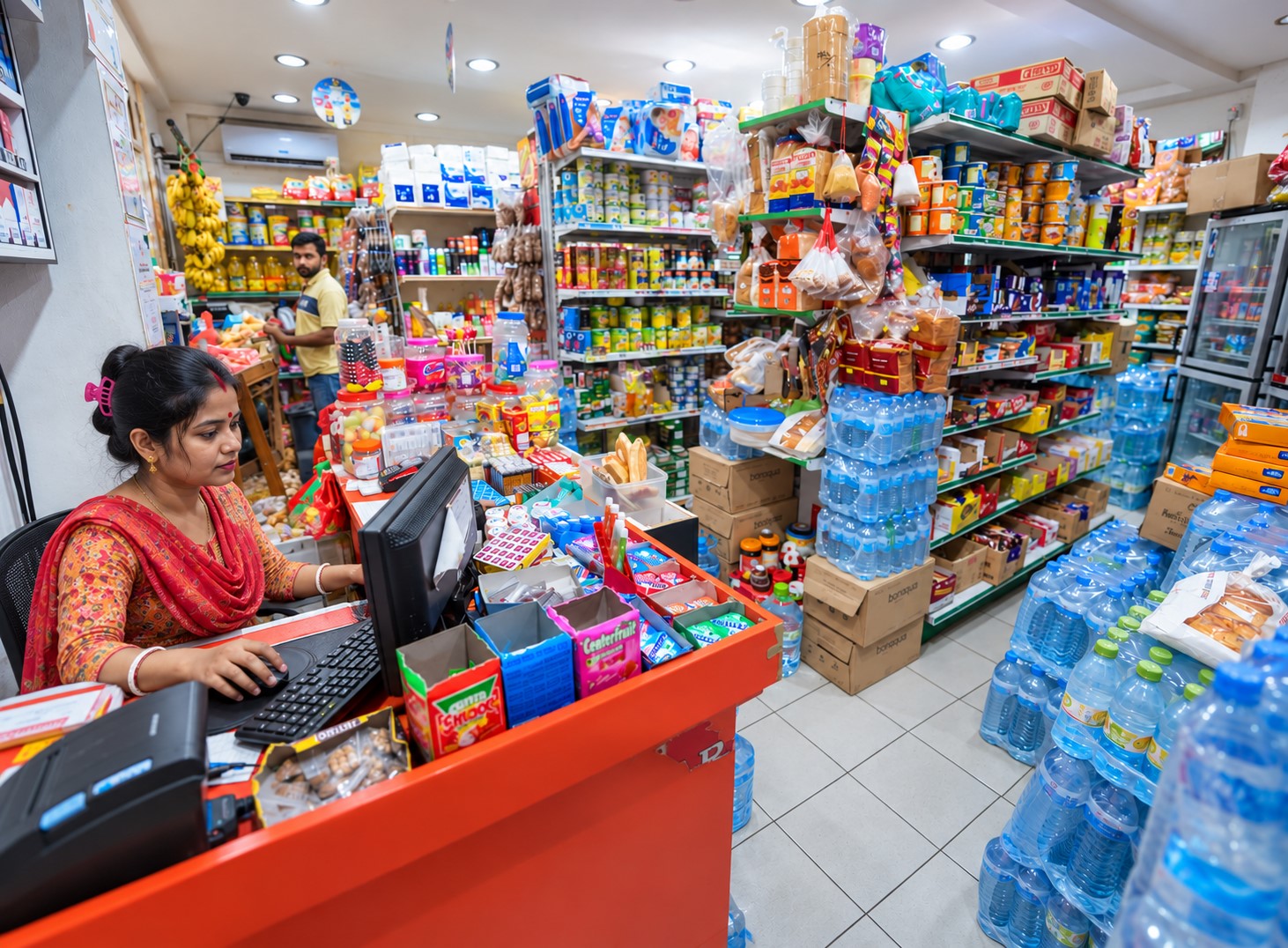
I recently stepped into a mart near Male’ Opticals on Orchid Magu. Behind the counter, handing out change and processing payments, was a middle-aged Indian woman. Based on the bindis on her forehead, it was reasonable to assume she was Hindu. She spoke fluent Dhivehi. Walking past the adjacent shop and a nearby restaurant, the scene was identical: entirely Indian and Bangladeshi expatriate workers. In fact, across most convenience stores and corner marts in the area, the counters are manned almost exclusively by foreign nationals from India, Bangladesh, Nepal, and the Philippines.
In one of Male’s busiest retail outlets, Asters, every single cashier counter is staffed by foreign women. The same picture unfolds at most of the large supermarkets and even coffee “Kadas” and beachfront spots like "Coco-Hut" at the Artificial Beach and even most of the garment shops. Across the capital Male’, the cashier position has slipped almost entirely into foreign hands. But this is not merely a question of who processes payments at the till. Along with cashiering, financial control, inventory ordering, and the day-to-day management of small and medium-sized enterprises have dangerously transferred to foreign workers.
Will the Government Yield to Business Pressures and Delay Policy Implementation?
In his presidential address delivered to the People’s Majlis earlier this year, President Dr. Mohamed Muizzu announced a firm policy prohibiting foreign nationals from working as cashiers in the Maldives. Under the government's phased policy timeline, starting February 5, 2027, no foreign worker will be permitted to work as a cashier anywhere in the country. This stands as a decisive reform after years of regulations existing solely on paper. Yet, given the history of economic reforms in the Maldives, a crucial question looms: when the deadline arrives, will the government succumb to pressure from business owners claiming unreadiness and postpone enforcement once again?
The Black Market Impact of Foreign Cashiers
This issue transcends basic workforce localization; it is a vital matter of national economic security directly tied to the country’s financial stability. When foreign workers control cash registers, local currency and US Dollars collected at retail outlets frequently bypass the formal banking system, flowing directly into underground money transfer operations. With recent legislative amendments to foreign exchange laws, trading foreign currency on the black market now carries heavy fines and criminal prosecutions. Cash generated daily at retail counters is often exchanged through informal expatriate networks, depriving the official banking system of essential foreign exchange liquidity.
25,000 Cashier Jobs and Economic Retention
Full enforcement of this regulation is projected to reclaim roughly 25,000 jobs for Maldivians nationwide, says the government. Reclaiming these positions would curb foreign exchange outflows, restore domestic control over retail enterprises, and significantly boost local currency circulation. Even if calculated at a conservative average salary of MVR 7,500 per cashier, 25,000 jobs represent MVR 187.5 million every month—or over MVR 2.25 billion annually—currently leaving the Maldivian economy through foreign remittances. Once the foreign cashier ban is strictly enforced, these funds will remain within the domestic economy, supporting local households and businesses.
At present, in many corner shops and retail marts, the Maldivian business owner acts as little more than a nominal sponsor. Daily cash management, supplier payments, and operational control rest with foreign cashiers, representing the first step toward illegal foreign business ownership.
Many private business owners prefer maintaining the status quo, citing unreliability, frequent sick leave, and high turnover among local staff. However, this argument overlooks the root cause: depressed wage structures. When factoring in work visa fees, quota charges, accommodation, food, annual return airfare, and medical insurance, the actual cost of employing a foreign cashier exceeds MVR 10,000 per month. If private businesses offered competitive wages matching these actual employment costs to local candidates, qualified Maldivians would stay in these roles. State-owned enterprises such as STO and MTCC successfully retain local cashiers long-term, proving that the shortage stems from private sector compensation and working conditions rather than inherent local reluctance.
Reducing Political Appointees and Civil Servants
Reclaiming cashier jobs cannot be achieved through administrative mandates alone; it demands structural adjustments across the economic and social framework. Currently, over 50 percent of the Maldivian labor force is employed by the government or state-owned enterprises (SOEs). To address this imbalance, civil service operations must be digitized, and public sector employment reduced or capped at no more than 30 percent of the national workforce.
Pension Office statistics show that the vast majority of formally registered Maldivian workers are employed within the civil service and state enterprises, a figure that grows larger when political appointments are included. In developed economies, public sector employment remains well below 30 percent of the total labor force. Overemployment in the public sector depletes the available pool of local labor for the private market.
Furthermore, lucrative political appointments that offer MVR 15,000 to MVR 25,000 per month with minimal or no workloads disincentivize youth from entering demanding private-sector jobs. By downsizing redundant political positions and automating administrative civil service functions through AI and digital workflows, the government can redirect young Maldivian talent into the private sector.
Failure to Enforce the 50 Percent Maldivian Quota in Resorts
While resort regulations mandate that at least 50 percent of employees be Maldivian, this rule remains largely ineffective in practice. Resort management frequently exploits regulatory loopholes through third-party outsourcing. By maintaining a 50 percent local ratio on their direct payroll while outsourcing entry-level roles—such as room attendants, cashiers, and housekeeping—to third-party contractors who employ low-wage foreign labor, resorts circumvent the spirit of the law.
Frontline roles like room attendants and cashiers can be readily performed by trained Maldivian youth and serve as primary touchpoints for showcasing local hospitality to tourists. Addressing this requires closing outsourcing loopholes, counting all contracted resort personnel toward the quota, and designating frontline operational roles exclusively for Maldivians.
Aligning Population Growth with Economic Expansion
The rapid expansion of the Maldivian economy stands in stark contrast to its low population growth rate, posing long-term demographic and economic challenges. A primary reason for the heavy reliance on foreign labor across emerging sectors is that the domestic population has not kept pace with economic growth.
To achieve sustainable self-reliance, national perspectives around family planning must shift from two-child families toward encouraging three or four children per household. To alleviate the financial burden on families, the government should launch a national incentive program providing monthly state allowances for every third and fourth child until they reach the age of 18.
Standing Firm Against Business Pressures Without Postponement
The decision to prohibit foreign cashiers represents a vital policy initiative after years of dormant regulations. However, the overarching test for Maldivian economic governance remains whether the government will enforce the policy when the implementation date arrives on 5th February next year, or yield to lobbying from business owners seeking delays.
The government must demonstrate firm resolve by enforcing this rule without compromise. Banning foreign cashiers is a fundamental step toward reclaiming national economic control, but its success depends on comprehensive reform: business owners abandoning short-term cost shortcuts, the government curbing redundant political posts to free up local labor, and authorities strictly enforcing foreign exchange and labor regulations. True economic sovereignty can only be secured when political leaders and business owners unite in prioritizing the national interest.