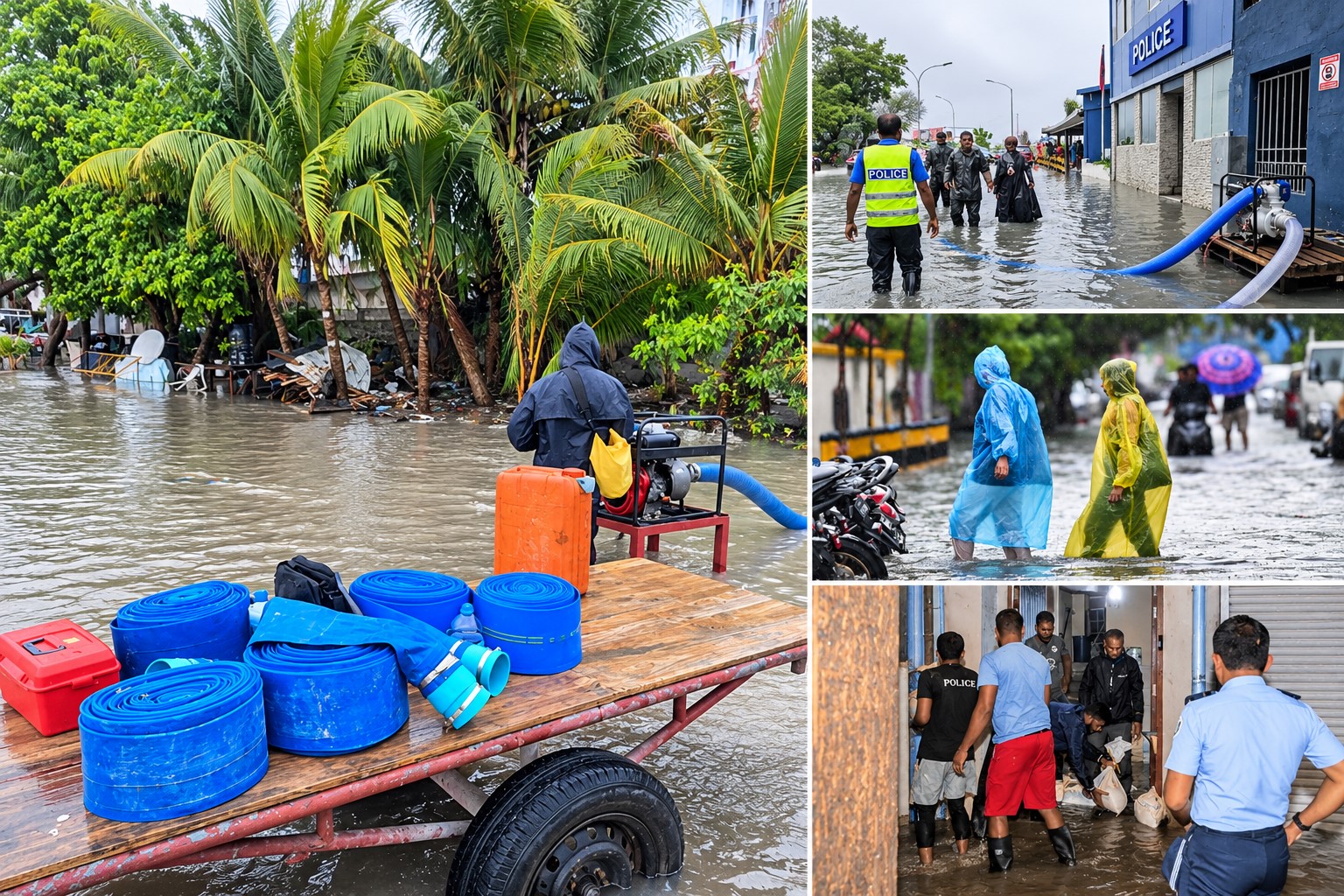
Every year as the southwest monsoon intensifies, a dark cloud and a brief downpour are all it takes to submerge the capital city of Malé and major islands across the atolls. Spending millions under the guise of emergency water pumping has become an all-too-familiar, tragic routine. The recent torrential rains of late October 2026—flooding 95 percent of homes in Hdh. Nolhivaranfaru, damaging over 190 households in Kulhudhuffushi City, and inundating more than 80 buildings and shops in Malé—are not mere coincidences. Deploying soldiers and police officers to pump out flooded streets and lay sandbags every time it rains is not a sign of state benevolence; it is a glaring testament to institutional incompetence and fiscal waste.
This recurring crisis is far more than an unavoidable act of nature or a seasonal squall. It is a severe national predicament born from the confluence of civil engineering oversights, flawed urban planning, political short-sightedness, and widespread civic neglect.
The Asphalt Delusion and Civil Engineering Realities
The persistent belief held by both the public and authorities that stripping old asphalt to lay new paving, or paving rural dirt roads, will permanently solve urban flooding stems from a fundamental misunderstanding of basic science. From a civil engineering perspective, asphalt and traditional paving blocks are impervious surfaces—materials through which water cannot penetrate. By destroying natural soil absorption under the banner of modern development and encasing entire islands in concrete and asphalt, every drop of rainfall is converted into surface runoff. Without an adequate, functioning storm drainage network—or when rainfall intensity far exceeds the design capacity of existing infrastructure—widespread inundation is mathematically guaranteed.
Furthermore, the problem is compounded by low hydraulic capacity and inadequate maintenance of street drainage catch basins. In Malé and major outer islands, drainage grates and storm networks are rarely cleared until a major flood event occurs. Accumulations of street dust, construction cement runoff, leaf litter, and urban waste settle into these channels, cutting their effective depth and reducing their drainage efficiency by more than half.
Climate Intensity and the Urban Heat Island Effect
Compounding these structural design flaws, climate change is driving a dramatic increase in global precipitation intensity. Meteorological data in the Maldives confirms that volume that once fell steadily over an entire day now discharges in short, intense bursts lasting just one or two hours. A rainfall volume of 90 millimeters within 24 hours is far beyond what dense, non-porous urban surfaces can naturally handle.
Moreover, major urban centers suffer acutely from the "urban heat island effect," where extensive concrete and asphalt trap immense solar heat. This thermal retention warms the localized microclimate, causing moisture-laden rain clouds moving over surrounding waters to rapidly condense directly over landmasses, intensifying localized downpours. Urban flooding is thus not merely a weather event; it is the direct scientific consequence of unmanaged, concrete-heavy urban transformation.
Political Neglect, Unplanned Growth, and Civic Behavior
Urban flooding is equally a manifestation of deep-seated political and social neglect. Uncontrolled population density and master planning that completely omits green spaces or natural retention areas leave zero unpaved ground for water infiltration. When every square meter of land is built over, stormwater has nowhere to go except into living rooms and storefronts.
At the same time, individual civic behavior plays a destructive role. Parking vehicles tightly along narrow lanes, leaving household waste bags on sidewalks, and carelessly discarding plastic bottles, wrappers, and cigarette butts directly onto streets leads to immediate blockages of drainage inlets during heavy rain. Every piece of litter tossed onto a public street becomes a physical dam obstructing stormwater flow when the skies open.
Kulhudhuffushi and Nolhivaranfaru: The Bitter Cost of Destroying Natural Wetlands
The tragic flooding in northern hubs like Kulhudhuffushi and Nolhivaranfaru highlights the disastrous consequences of poor ecological decision-making. Historically, Kulhudhuffushi possessed a massive natural mangrove lagoon and extensive wetlands that functioned as a giant ecological sponge, naturally absorbing excess rainwater. Sacrificing these vital wetlands for airport construction and heavy infrastructure without adequate hydrological mitigation stripped the island of its primary natural flood defense mechanism.
Similarly, in Nolhivaranfaru, where 95 percent of homes were inundated, road development was executed merely by leveling dirt tracks without conducting comprehensive hydrological assessments or mapping natural drainage channels. When political leaders execute unstudied infrastructure projects in direct opposition to natural island geography, citizens inevitably pay the price.
Pervious Paving and Nature-Based Infrastructure Solutions
To achieve permanent resilience, the state must move past reactionary emergency measures like cutting sea trenches and deploying mobile water pumps. In Malé and regional hubs, storm drainage design must be upgraded to modern hydraulic standards capable of managing climate-intensified rainfall volumes, directing runoff into high-capacity storage reservoirs or ocean outfalls.
Additionally, municipal authorities must institute mandatory preventive maintenance schedules to clear drainage basins long before monsoon storms hit. Road construction standards must transition away from solid asphalt toward pervious paving (permeable pavers) and vegetated channels known as bioswales. Permeable pavers allow stormwater to filter directly through micro-pores into the underlying soil, while bioswales along street margins use vegetation and soil layers to absorb and filter runoff before it overwhelms drainage networks. Integrating these green engineering solutions can reduce surface runoff by up to 50 percent.
A Clear Verdict
To answer the core question: urban flooding in the Maldives is neither solely a civil engineering failure nor exclusively a political or social issue. It is the cumulative result of all three. Failing to conduct rigorous engineering studies, paving over natural soakaways, and destroying natural wetlands represent profound urban planning failures. At the same time, dumping litter into drainage channels reflects an ongoing failure of individual civic duty.
Watching homes, shops, and livelihoods submerge after a brief downpour cannot remain an accepted norm of Maldivian life. Until technical engineering standards are modernized, political decision-making respects island hydrology, and public civic habits improve, Maldivians will remain trapped in an endless cycle of sandbags, emergency pumps, and preventable devastation with every passing storm.