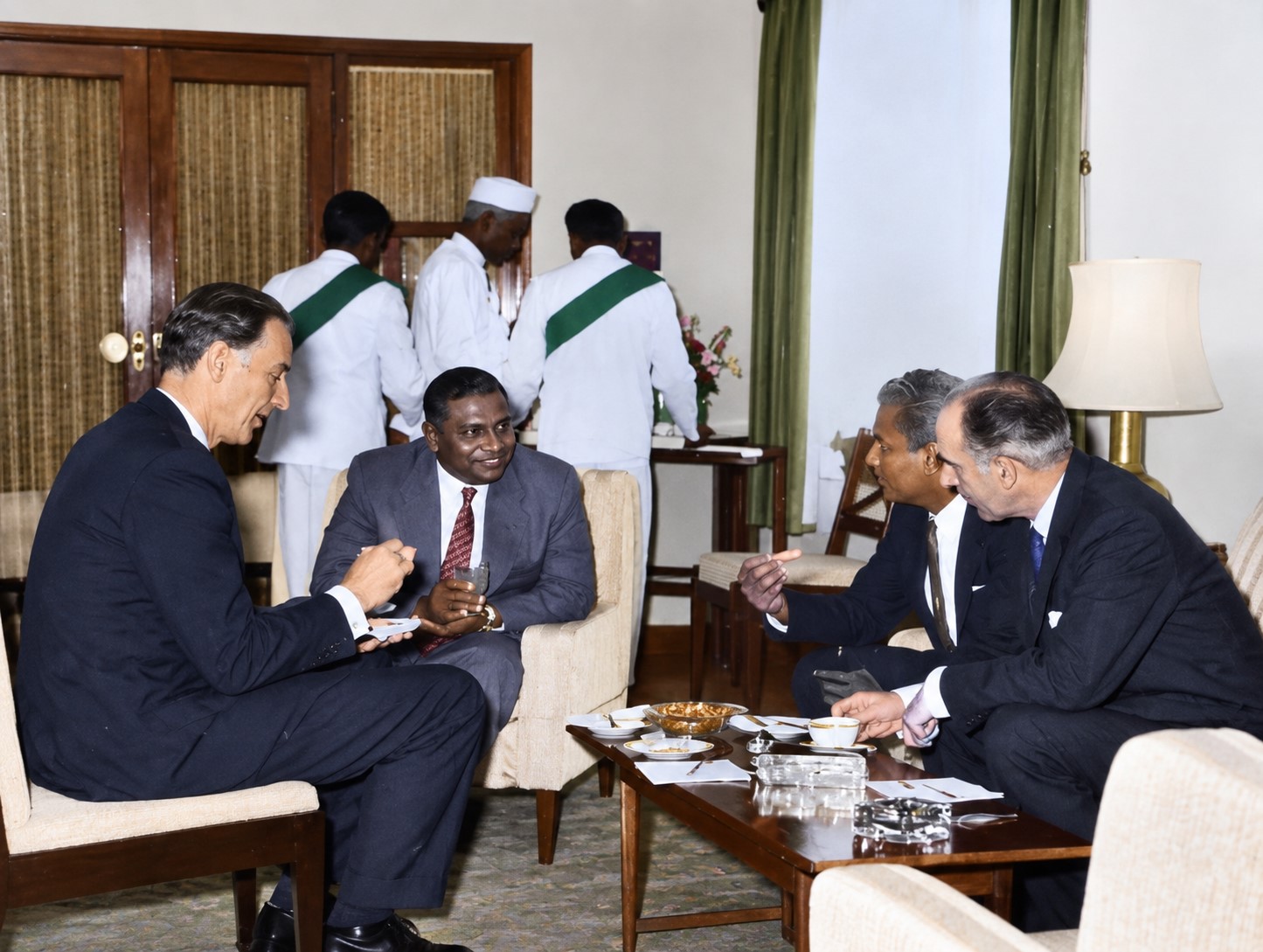
When Nasir assumed the office of Prime Minister in December 1957, the Maldives was an impoverished, isolated British protectorate. The regional geopolitical atmosphere was fraught with competing international interests, particularly with the British maintaining strong political and military footholds in the southern atolls, notably Addu. The early chapters of Nasir’s political career were defined by unyielding nationalism and a fierce determination to defend Maldivian sovereignty against British interference.
His crowning foreign policy achievement came on July 26, 1965, with the signing of the Independence Agreement in Colombo. This historic accord severed centuries of British protectorate status, granting the Maldives full political independence. Recognizing that true independence requires global affirmation, Nasir secured the Maldives' membership in the United Nations in September 1965, signaling to the world that the Maldives was a self-governing, sovereign state. Three years later, in 1968, following a national referendum that brought an end to an 800-year-old monarchy, he ushered in the Second Republic and assumed office as its founding President.
Architect of the Three Economic Pillars
While political independence stands as Nasir’s greatest diplomatic triumph, his economic legacy rests on three foundational pillars: Hulhulé Airport, the tourism industry, and a modernized fisheries sector. Today’s Maldivian economy—sustained primarily by aviation, tourism, and fisheries—was conceived, developed, and launched directly under President Nasir’s visionary leadership.
Airport and Air Maldives: Aviation and Strategic Connectivity
Recognizing that an isolated island nation could never progress without an international gateway, Nasir initiated the construction of an asphalt runway on the island of Hulhulé (now Velana International Airport). When foreign experts dismissed the project as impossible and heavy machinery was virtually non-existent, Nasir bypassed bureaucratic red tape and mobilized the entire nation. Leading by example, he personally joined the citizens of Malé on the tarmac, carrying coral stones by hand and clearing land to construct the runway that finally linked the Maldives to global travel and trade routes. Shortly thereafter, he established the national carrier, "Air Maldives," cementing the two critical foundations for the country’s future tourism boom.
Launching the International Tourism Industry
When international economic consultants concluded that the Maldives was entirely unviable for tourism due to a complete lack of fresh water, electricity, and transport infrastructure, President Nasir refused to accept their verdict. Seeing the untapped potential of the nation's natural beauty, he encouraged local entrepreneurs and facilitated the opening of the country’s first resort, Kurumba Maldives, in 1972. What began as a modest venture on a sandy island quickly transformed into a world-class luxury tourism industry.
Industrializing Fisheries and the Felivaru Cannery
While tourism offered future promises, fisheries were the immediate lifeblood of the economy. In the early 1970s, Sri Lanka—which purchased nearly 90 percent of Maldivian fish exports—faced severe financial turmoil and abruptly halted fish imports from the Maldives, threatening the country with economic collapse. At this perilous moment, Nasir demonstrated masterful crisis management. To pivot away from traditional dried fish exports, he negotiated agreements with Japanese firms, notably Hoko Fishing Company (Hoko Maldives) and Marubeni Corporation, to purchase raw skipjack tuna directly for cash. Japanese freezer vessels were stationed in the northern and central atolls, allowing local fishermen to sell their catch immediately for hard currency.
Furthermore, in 1974, Nasir’s administration collaborated with Japan’s Yanmar Company to mechanize the traditional Maldivian fishing fleet (dhonis) and sent local technicians to Japan for specialized training. Mechanization allowed fishermen to venture further offshore, unimpeded by wind and sea currents. These transformative steps culminated in 1977 with the opening of the Felivaru Canning Factory in Lhaviyani Atoll, permanently industrializing the Maldivian fishing sector.
Economic Independence and Social Liberation
A central tenet of Nasir’s economic agenda was liberating the domestic economy from foreign domination. To this end, he dismantled the entrenched influence of the Indian Bora merchants who dominated the Malé market and oversaw their departure from the country. At the same time, he laid the groundwork for a modern financial infrastructure by introducing foreign commercial banks to facilitate domestic trade and investment.
Liberating Maldivian women:
On the social front, Nasir executed a groundbreaking reform by liberating Maldivian women and integrating them directly into the educational, economic, and civic spheres. Rejecting the traditional confinement of women within the four walls of the home, he championed women as equal partners in national development, opening unprecedented opportunities for female public service and employment.
Modernizing Education, Health, and Media Infrastructure
In building a modern state, President Nasir systematically established foundational institutions and essential public services:
Educational Revolution: He transformed the educational landscape by introducing English-medium teaching at the country’s premier historical institutions, Majeedhiyya and Aminiya schools. To ensure Maldivian students could compete globally, he introduced the UK’s "London O-Level" examinations, creating a direct pathway for Maldivians to pursue higher education abroad and cultivating a skilled cadre of professionals to build the nation.
Media and Communications: To foster civic awareness and accelerate public communication, Nasir modernized the country’s broadcast infrastructure. He launched "Radio Maldives" to disseminate news across the archipelago and oversaw a regional milestone by establishing "TV Maldives" (TVM), creating an instant platform for news, educational programming, and national unity.
Healthcare Infrastructure: As the cornerstone of modern healthcare, Nasir established "Central Hospital" in Malé. This facility provided the Maldivian public with access to scientific diagnosis and clinical treatment for prevalent life-threatening diseases, marking a historic transition from traditional herbal medicine to a modern, professional healthcare system.
Maritime Logistics: To safeguard maritime trade routes and alleviate geographic isolation, Nasir founded the national shipping enterprise, Maldives Shipping Limited (MSL). MSL not only secured the import of vital goods for the nation but also generated substantial foreign exchange revenue for the state through international maritime commerce.
Decisiveness, Impartiality, and the Rule of Law
Nasir’s presidency is frequently characterized as centralized and authoritarian. When faced with existential threats to national unity—most notably the secessionist movement of the "United Suvadive Republic" in the southern atolls during the late 1950s and early 1960s—he responded with swift, uncompromising resolve. He treated the rebellion not as a subject for political compromise, but as a direct challenge to the territorial integrity of the state.
Some see this event as Nasir’s authoritarianism. Yet, historical accounts reveal that alongside his firm posture lay a profound commitment to impartiality, fairness, and the rule of law. Under Nasir’s administration, state governance operated without regard to noble lineage, social status, or family ties. To demonstrate that no citizen stood above the law—without exception for his own bloodline—when his own son violated maritime regulations, Nasir ordered his arrest and prosecution under the full weight of the law. This unyielding stance reflected his core governing philosophy: public office was a sacred duty owed to the nation, never a vehicle for familial enrichment or personal privilege.
Integrity: Eradicating Systemic Corruption
Though contemporary critics point to the concentration of executive authority during his presidency, historians and contemporaries highlight a stark defining trait of his administration: Though Nasir controlled things personally, he maintained absolute zero tolerance for institutional corruption, bribery, or financial malfeasance for anyone else.
Even as he personally oversaw state enterprises and financial operations, he acted as a fierce guardian against the misappropriation of public funds. Under his rule, no cabinet minister, atoll chief, or civil servant was permitted to enrich themselves at the expense of the state. Those who attempted to misuse their position faced immediate dismissal, exile, or prosecution. By eradicating corruption and instilling rigorous administrative discipline, every laree of state revenue was channeled directly into public infrastructure and national development. In an era where modern governance is frequently burdened by political patronage, partisan favoritism, and fiscal waste in state-owned enterprises, Nasir’s administrative discipline remains an exemplary model.
A Leader Unlike Modern Politicians
President Ibrahim Nasir was entirely distinct from typical politicians; he never sought public adulation, nor did he indulge in factional political maneuvering. He was a quiet, reserved, and fiercely independent architect of statehood. Operating in an era devoid of substantial financial resources, modern technology, or established diplomatic networks, Nasir demonstrated an indomitable resolve to construct a sovereign nation. Today’s modern Maldives—with its international airport, world-class tourism, mechanized fishing fleet, and constitutional republic—stands as a living testament to his quiet ambition.
Retirement, Passing, and Enduring Historical Legacy
In 1978, at the height of his authority, Nasir made a decision that reflected his extraordinary and unique character: he voluntarily declined to seek another term as President. Without fanfare or political drama, he quietly stepped down, relinquished power, and retired to Singapore, paving the way for the transition to the leadership of Maumoon Abdul Gayoom.
Although the immediate aftermath of his presidency brought political tension, state investigations, and years of exile, the passage of time cleared the historic lens through which his contributions were viewed. In his later years, he was officially recognized as the national hero who laid the foundations of the modern Maldivian state and economy, earning full official honors and pardons.
When President Ibrahim Nasir passed away in Singapore in November 2008 at the age of 82, he left behind a nation fundamentally transformed from the impoverished, protected enclave he had inherited a half-century prior. Following his passing on November 22, 2008, his body was repatriated to Malé aboard a specially chartered flight, where he was accorded a full state funeral attended by thousands of grieving citizens. In a symbol of supreme historical respect, he was laid to rest in the grounds of the historic Malé Friday Mosque (Hukuru Miskiy)—situated precisely in the triangle between his ancestral home Velanaage, the President’s Office, and Mulee'aage.
There, in quiet dignity at the historic heart of the Republic he sacrificed so much to build, rests President Ibrahim Nasir. His life and legacy stand as an enduring beacon and a timeless lesson for the leaders of today.